






2023 Grand Wagoneer review from Caranddriver.com
2023 Jeep Grand Wagoneer
by ERIC STAFFORD
Overview
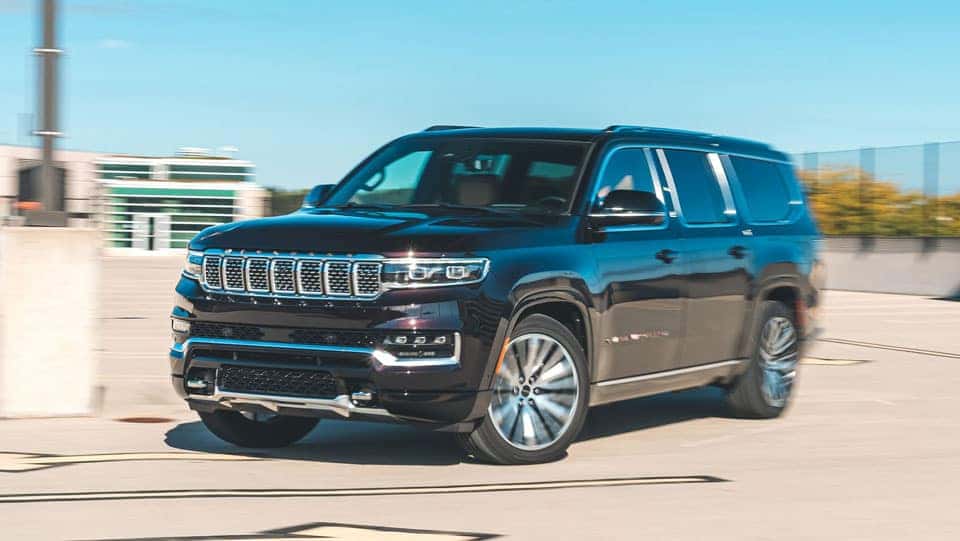
Before the Grand Wagoneer arrived, Jeep had never built an SUV so big and luxurious. Within its enormous shell are three rows and seating for up to eight, not to mention attractive materials and upscale features throughout. The long-wheelbase Grand Wagoneer L has more storage space behind all those seats, too. Unfortunately, the longer version also will be more difficult to maneuver than its already cumbersome counterpart. Regardless of length, the largest Jeep suffers from terrible fuel economy, with a combined EPA rating of just 16 mpg. That estimate isn’t for a big-displacement V-8, either, but a new twin-turbo six-cylinder with 510 horsepower. At least that engine should get the 2023 Jeep Grand Wagoneer and its precious cargo where it needs to go on time and in exceptional comfort. For those not looking to spend six figures, the Jeep Wagoneer is a less expensive alternative.
What’s New for 2023?
For 2023, the Grand Wagoneer L joins the lineup. Its wheelbase is seven inches longer than the standard Wagoneer, and it’s a foot longer overall. These extensions contribute to considerably more cargo space behind all three rows of seats. Under the hood, the long-wheelbase model has Stellantis’s new Hurricane engine, which is a twin-turbo 3.0-liter inline-six that makes 510 horsepower and 500 pound-feet of torque. While it is standard on the stretched Grand Wagoneer L, a 471-hp 6.4-liter V-8 is still available on the base trim of the regular Grand Wagoneer.
Pricing and Which One to Buy
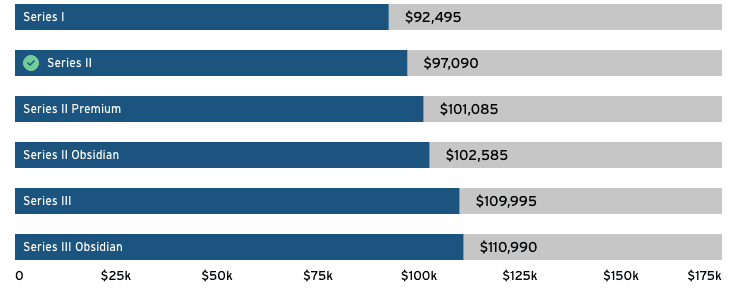
We think the Series II trim level looks to be the best value. It comes standard with 22-inch wheels, a two-tone roof, a 10.3-inch touchscreen for the front passenger, nicer leather-trimmed upholstery, a rear-seat monitoring system, and additional driver assists such as night vision and a semi-autonomous drive mode.
Engine, Transmission, and Performance
With the introduction of the new long-wheelbase Grand Wagoneer L comes a new engine. Dubbed the Hurricane, the 510-hp twin-turbo 3.0-liter inline-six pairs with an eight-speed automatic transmission and all-wheel drive. While this engine comes standard on the stretched Grand Wagoneer L, the standard-wheelbase model can still be had with the 471-hp 6.4-liter V-8 powertrain, but only on the base model. The new I-6 is the engine to get anyway, as it beat the older V-8 in our acceleration testing, propelling the Grand Wagoneer L to 60 mph in just 4.7 seconds. As with its domestic rivals, the Grand Wagoneer utilizes body-on-frame underpinnings, in this case, derived from the Ram 1500 pickup truck. However, the Jeep features an independent rear suspension rather than the truck’s solid rear axle, which gives the SUV a smoother ride and better handling than the Ram. Along with several four-wheel-drive systems, the Grand Wagoneer offers an adaptive air suspension that can raise its ride height up to 3.6 inches or lower it by a half-inch. It also boasts 10 inches of ground clearance, up to two feet of water-fording capability, and a max tow rating of 9860 pounds.
Fuel Economy and Real-World MPG
With the inline-six, the 2023 Grand Wagoneer is rated for 14 mpg city and 20 mpg highway; going with the long-wheelbase L model drops the highway rating to 19 mpg. Those figures are slightly better than models powered by the 6.4-liter V-8, which are rated at 13 mpg city and 18 mpg highway. On our 75-mph highway route, which is part of our extensive testing regimen, the Grand Wagoneer L with the inline-six delivered 20 mpg. For more information about the Grand Wagoneer’s fuel economy, visit the EPA’s website.
Interior, Comfort, and Cargo
With standard three-row seating and space for either seven or eight passengers, the Grand Wagoneer provides large families an opportunity to live the Jeep lifestyle, which hasn’t been possible since the old and unloved Commander was around. A pair of second-row captain’s chairs are standard, but a bench seat is available for maximum passenger capacity. As the luxury version of the regular Wagoneer, its cabin is loaded with elegant environs, such as genuine wood accents, and high-tech features, such as a 12.3-inch fully digital gauge cluster. The interior also boasts “Easter eggs” inspired by the original Grand Wagoneer, including an old-school-inspired two-spoke steering wheel and an “EST. 1963” inscription that appears on the edge of the dashboard when you open the door. Along with customizable ambient interior lighting, this grandest of Wagoneers offers a head-up display, a camera-fed rearview mirror, and a rear-seat monitoring system that displays a video feed onto the central touchscreen. On the standard-wheelbase model, the cargo area behind the third row measures 27 cubic feet, and stowing it provides 71 cubes behind the second row. On the long-wheelbase model, there are 44 cubic feet behind the third row and 89 cubes with the second row of seats folded flat.
Infotainment and Connectivity
One of the most dazzling aspects of the Grand Wagoneer is its multifaceted infotainment system. Even without including the digital gauge cluster, the Jeep’s dashboard is covered in screens. The main focus is the center stack, which packs a 12.0-inch center touchscreen that sits above a 10.3-inch touchscreen with controls for the HVAC system. Starting on the Series II, there’s yet another 10.3-inch touchscreen for the front-seat passenger. Desirable standard features include a subscription-based Wi-Fi hotspot, wireless Apple CarPlay and Android Auto, and USB ports in all three rows. Second-row passengers are also treated to another 10.3-inch touchscreen between the captain’s chairs; opting for the rear-seat entertainment system adds a pair of 10.1-inch touchscreens. Every Grand Wagoneer has a powerful McIntosh stereo, but the Series II and up get a more powerful 1375-watt unit with 23 speakers.
Safety and Driver-Assistance Features
Not only is the Grand Wagoneer fitted with a suite of standard driver-assistance technology, but the luxury SUV is also available with an equally wide array of additional assists. These include adaptive cruise control, a self-parking function, and night vision with pedestrian and animal detection. A semi-autonomous mode that allows hands-free driving will also eventually be offered. For more information about the Jeep’s crash-test results, visit the National Highway Traffic Safety Administration (NHTSA) and Insurance Institute for Highway Safety (IIHS) websites. Key safety features include:
- Standard forward-collision warning and automated emergency braking
- Standard blind-spot monitoring and rear cross-traffic alert
- Standard lane-departure warning and lane-keeping assist
More from Anderson Chrysler
2026 Jeep Grand Cherokee L Laredo Review: Three-Row Jeep Capability for Everyday Family Life
The 2026 Jeep Grand Cherokee L Laredo is built for drivers who want Jeep capability, three-row space, and everyday comfort without jumping straight into the highest trim levels. It gives families a smart entry point into the Grand Cherokee L lineup while still delivering the size, strength, and confidence expected from a Jeep SUV. At…
2026 Jeep Cherokee: A Smarter SUV for Arizona Drivers
The 2026 Jeep Cherokee is back, and it arrives with the kind of updates that make it a strong fit for drivers who want everyday comfort without giving up Jeep capability. At Anderson Chrysler Jeep Dodge Ram, the Cherokee stands out as a midsize SUV that feels ready for daily commutes, weekend road trips,…
Built for the Desert: Exploring the 2026 Jeep Gladiator
The 2026 Jeep Gladiator is still the only midsize pickup that’s truly a Jeep at heart — removable doors, open-air freedom, real 4×4 hardware, and a usable truck bed in the back. For Arizona drivers who split time between pavement, dirt roads, lake weekends, and trails, Gladiator remains a one-of-one kind of truck. This…
Go Anywhere in Style: The New 2026 Jeep Wrangler
The 2026 Jeep Wrangler stays true to its legendary off-road roots while adding smarter tech, more comfort, and a big new headline: the Wrangler Moab 392 V8 model. For drivers in Lake Havasu City, Parker, Bullhead City, and Kingman, it remains the go-anywhere, do-anything SUV — from serious trail work to daily commuting. You can…
0 comment(s) so far on 2023 Grand Wagoneer review from Caranddriver.com